
Disease, fire, violence, and law
Newspapers across Georgia followed the 1899 smallpox outbreak at Barney. They reported diagnosis, isolation, guarded quarantine, death, additional infection, medical response, and alarm in neighboring communities. The accounts disagreed over the first patient's identity, calling him Robert, R. J., or C. D. Paxson or Paxton. They also disagreed about who died, who remained sick, and how many cases occurred.[26]
The earliest reports placed a man associated with Abbeville and the milling business at Barney under Dr. Bourquin's care. Quitman physicians confirmed smallpox, and Barney or exposed households were quarantined. Reports said the patient had recently spent time in Adel, which spread concern along the railroad and work routes. Later accounts placed one or more additional patients under guard and named Dr. A. S. Humphreys of Autrey, Florida, as an attending specialist. In April 1900, a Lowndes County smallpox report still referred back to the Barney cases.[26]
The later reports distinguish the man who died from his infected brother and the Black nurse who had cared for him. Robert Paxson is the strong-probable identification of the deceased man, and Charles Dorothus Paxson the strong-probable identification of his brother. The unusual surname, the reported brother’s initials, the outbreak sequence, and the Barney mill connection support that reconstruction; a direct family record joining the brothers has not been found. The conflicting newspaper spellings and initials remain part of the record. A complete patient list, exact case count, and the Black nurse’s identity remain unresolved.[26]
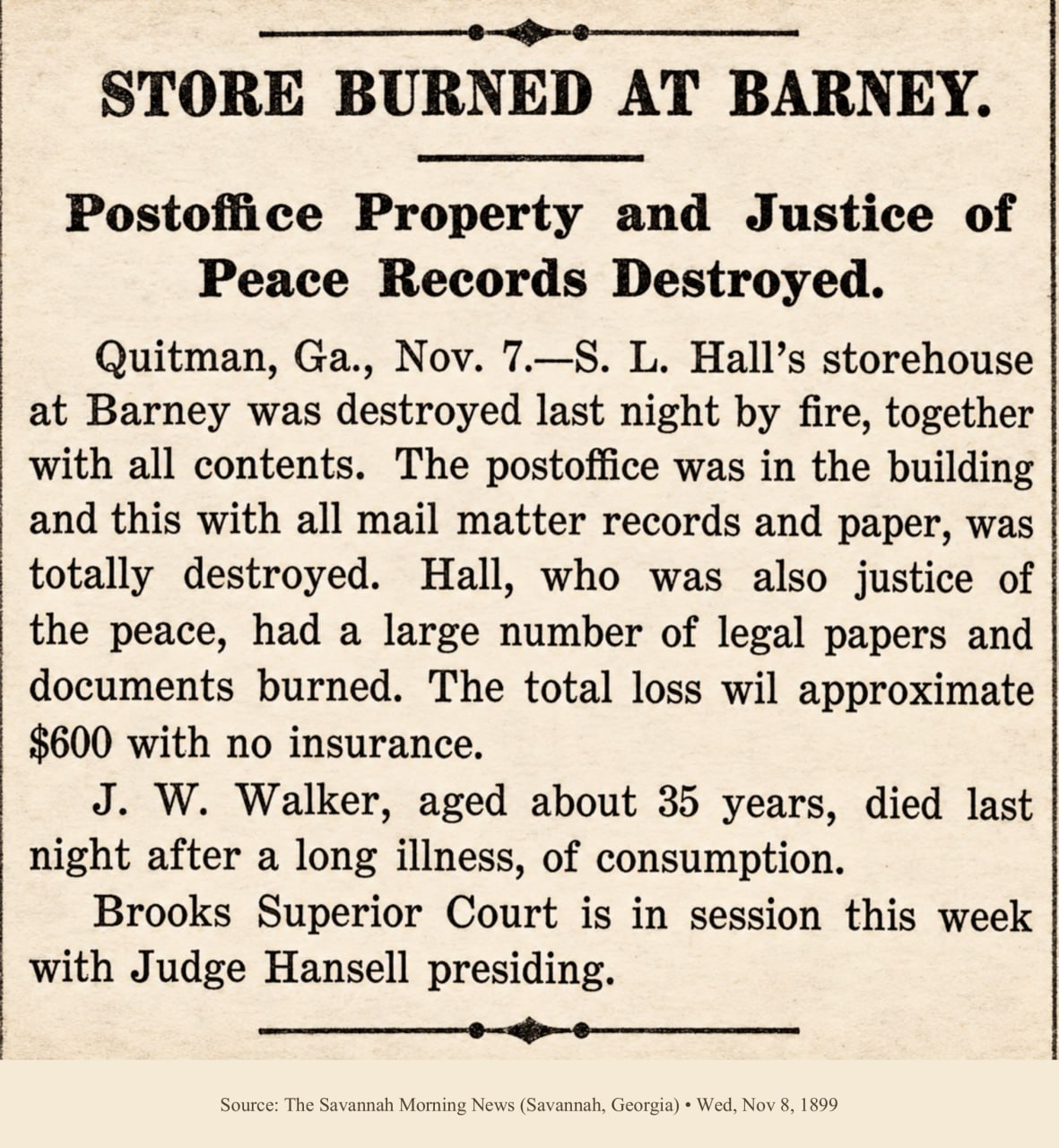
The Hall store and post-office fire of November 1899 destroyed mail, commercial records, merchandise, and justice-court papers. In May 1903, fire destroyed Moran's store and two Edenfield & McMillan buildings while threatening the depot and other businesses. Residents fought the 1903 blaze and saved merchandise, the depot, and nearby stores. No pre-charter record has been found for a municipal fire service.[21][22]
In July 1900, Sheriff Connolly returned Ed Blount from Bronson, Florida, to face a charge connected with the 1897 killing of Ben Smith, a Black worker, near a turpentine still. One account said Blount fired at Adam Allen during a dispute and struck Smith instead. No court record has been located to establish the outcome of the charge.[16]
A March 1900 dispatch reported that Joe Hodges shot a man named Perry twice after an argument over a remark about Hodges's brother-in-law. One bullet reportedly struck near Perry's heart and was considered dangerous. No later medical or court result has been located.[10]
The January 1901 seizure and killing of a Black prisoner requires even greater care. Newspapers called the man Eli, Joe, or Dave Dotson, and some printed Dobson. They said Justice Hall of Barney committed him to jail and placed him in the custody of Bailiff Pace for transport toward Quitman. Contemporary reports describe a Black crowd forming near Barney and later overtaking Pace near Kennedy's Siding. The reports say Dotson was shot and killed; one adds that he broke away and tried to run before the crowd fired. The papers also printed accusations against him, but those allegations were never adjudicated and should not be repeated as established facts.[27]
In May 1901, a body was recovered and an inquest concluded that the man had died at unknown hands. One report placed the body in Little River above the South Georgia Railroad bridge north of Barney and named Coroner Ponder, Esquire S. L. Simmons, and jurors Fleming Bates Walker, W. C. Edenfield, George P. Hall, J. W. Kendrick, James Chambers, and H. T. Patterson. The newspaper printed Walker's name as “F. B. Walker.” The initials, place, date, and his documented role in Barney make the identification strong probable. Other reports used conflicting geography involving the Withlacoochee and Little River areas. No member of the mob was identified in the located record.[27]
Before incorporation, public order rested with county officers, justices of the peace, constables, coroners, and informal local arrangements. Hall's store held justice-court papers. Justice Hall and Bailiff Pace, also called Constable Pace in some reports, appeared in the Dotson accounts. Rev. J. W. Folsom later wrote that he had once served as a notary public in the Barney district. No located pre-charter record names a Barney mayor, council, police department, municipal tax, or town election.[21][25][27]
Physicians in the district
Dr. Stephen William Bourquin practiced in Foster before Barney developed. Huxford's county history remembers him as Barney's first physician. A March 1894 Foster notice placed his son, Dr. Ed Bourquin, in practice with him, and contemporary reports show the elder doctor's medical work at Barney during the 1899 smallpox outbreak.[26][30]
The 1900 Barney precinct census recorded Bourquin, whose surname was transcribed as Bourguine, and Edwyn Thompson as physicians. Their household records place them in the precinct, not at a verified town-center office.[28]
Dr. Alexander S. Humphreys Jr., the A. S. Humphreys named in the 1899 smallpox reports, later became a resident Barney physician. The outbreak report described him as coming from Autrey, Florida, and the 1900 census placed him in Jasper, Florida. By 1910—after incorporation—his family lived on First Avenue in Barney, where the census recorded him as a medical doctor working on his own account. His 1910 household and dossier follow that later part of his career.[26][29]
Sources used on this page
- [10] Morning News, March 7, 1900, South Georgia Railway dividend, extension, Barney mileage, and Joe Hodges shooting dispatch.
- [16] Morning News, July 26, 1900, Ben Smith and Ed Blount report, Georgia Historic Newspapers; related July 1900 Valdosta Times report.
- [21] Atlanta Constitution and Morning News, November 8, 1899, S. L. Hall store and post-office fire, Newspapers.com images 26863153 and 852570010.
- [22] Morning News, May 17, 1903, Barney store fire, Georgia Historic Newspapers; Valdosta Times, May 19, 1903, related fire report.
- [25] Atlanta Constitution, February 4, 1902, Rev. J. W. Folsom notary letter.
- [26] Representative smallpox coverage: Morning News, August 12 and 19, 1899, August 12 and August 19; Macon Telegraph, August 14, 18, 20, and 31 and September 7, 1899, plus April 5, 1900; Moultrie Observer, September 1, 1899, archive page.
- [27] Representative Dotson or Dobson coverage: Morning News, January 4, 1901, Georgia Historic Newspapers; Waycross Weekly Herald, January 5, 1901, Georgia Historic Newspapers; Morning News, May 17, 1901, Georgia Historic Newspapers; Valdosta Times, May 21, 1901, Newspapers.com image 889667736.
- [28] 1900 U.S. census, Barney precinct, Brooks County, Georgia: Edwyn Thompson household and Stephen Bourguine household.
- [29] 1900 U.S. census, Jasper, Hamilton County, Florida, Alexander S. Humphreys household, Ancestry record 34032712; 1910 U.S. census, Barney, Brooks County, Georgia, A. S. Humphreys household, Ancestry record 3199085. See the Humphreys dossier for the identity evidence and medical chronology.
- [30] Valdosta Times, March 24, 1894, page 1, “Foster Notes,” clipping 193408136, Dr. Ed Bourguin entering practice with Dr. S. W. Bourquin; Folks Huxford, The History of Brooks County, Georgia, 1858–1948 (1948), Barney and local-physician accounts. The first-physician description is Huxford's later historical account.