
Commerce and industry
Barney's first municipal years remained tied to timber, rail transportation, farming, and a small business district.
Taxable property and regional industry
Brooks County's 1903 tax digest listed the Barney district at $140,730 in taxable value, an increase of $17,426. The figure measures the district's tax base rather than its population, but it provides an economic baseline at the time of incorporation.
Newspaper coverage in 1905 and 1906 placed Barney & Smith in discussions of timber and railroad development around Milltown, Naylor, and Valdosta. On October 4, 1906, the Valdosta Daily Times reported that three possible Milltown-to-Valdosta routes had been surveyed for N. E. Whitehurst, manager of the Barney-Smith railway interests. The survey recorded timber and open land along each route. These reports do not establish that Barney & Smith owned the South Georgia Railway.
Edward C. Bridges's 1909 obituary supplies a personal example of the same economy. It says he moved to Brooks County nearly fifteen years earlier, settled at Barney, and worked in sawmilling with the Oglesbys before entering a wider group of lumber, grocery, hardware, banking, and naval-stores businesses.
A March 27, 1910, Atlanta Journal county profile described the South Georgia Railway from Adel through Quitman to Perry, Florida, and named J. W. Oglesby as its president and superintendent and as a central figure in the Oglesby Lumber and Manufacturing Company. Barney was one town along that regional rail-and-lumber system.
Cotton remained active as well. On August 13, 1909, the Valdosta Daily Times reported that the gins at Morven and Barney had run full time the previous day.
The naval-stores trade also continued around Barney. On December 9, 1904, the Moultrie Observer described H. D. Woolard as a naval-stores operator of Barney.
The business district in 1908
A December 1908 town profile listed six general stores, a hardware and furniture business, a drugstore, a bank, a cotton gin, a meat market, a hotel, two blacksmith shops, a turpentine plant, a livery stable, a fireproof warehouse, two churches, and a school. It also counted four brick stores and a brick bank building, with two more brick buildings planned.
The correspondent estimated that Barney conducted about $150,000 in business each year and called it the largest shipping point on the South Georgia Railway between Adel and Greenville except Quitman. Those claims appeared in an argument for a better road to Valdosta and should be read as promotion. The detailed inventory, however, documents the range of businesses operating in the town.
The official 1908 Brooks County map marks a “Still” at the south end of First Avenue in LL320. A deed chain from the same period points strongly to the turpentine still operated by Spivey & Nesmith. Sallie A. Rozier conveyed them 8 6/7 acres in LL320 on January 4, 1907. John Berryhill added a quarter-acre road-corner parcel that December. On August 15, 1908, J. F. Spivey conveyed W. P. Carter a one-third interest in the combined property, expressly identifying it as “the land on which the turpentine still of Spivey & Nesmith is located.”
The agreement of date, land lot, business type, and general location makes the mapped still's identification as the Spivey & Nesmith operation strong probable. The map itself does not name an operator, and the full tract has not been overlaid precisely enough to call the match verified. By 1910, a Spivey & Carter security deed described a 25-barrel still, steam pump and boiler, still buildings, dwellings or shanties, wagons, tools, barrels, turpentine cups, rosin, and spirits of turpentine on the Barney property.
The south-side commercial strip in LL279
The brick commercial row on the south side of Main Street, then called Ninth Street, developed through a series of small conveyances in Land Lot 279. No single deed tells the whole story. The record survives in pieces: an acre at the northwest corner of the land lot, several store-sized parcels, four numbered business lots that can be located with confidence, and three eastern lots whose early chains remain incomplete.
The AME acre
On February 25, 1896, Celia A. Davis conveyed African Methodist Episcopal Church trustees a square acre at the exact northwest corner of Land Lot 279. Its north and west boundaries followed the original land-lot lines, placing it at the corner later occupied by the south-side business district. The deed does not divide the acre into commercial lots.
The church trustees conveyed Jordan Baker a half-acre on November 22, 1899. That transaction was not recorded until 1921, and the available index gives no boundary description. Until Deed Book 33, page 108 can be inspected, the evidence does not show which half Baker received or how that conveyance related to the later seven-lot row.
Early storefront parcels
Other owners were carving store-sized parcels from Land Lot 279 as Barney grew. Ancil Lawrence sold William McCoy an 80-by-25-foot parcel in November 1897. The same year, C. H. Berryhill conveyed J. R. Anderson a 50-by-75-foot parcel. Neither surviving deed assigns a business-lot number, so their exact places in the later row remain unresolved.
A third parcel can be followed more fully. Lawrence conveyed W. H. B. Spell a 29-by-75-foot tract in October 1899. Spell sold it to Ada Smith in 1901; Frank and Ada Smith conveyed it to E. B. Thompson in January 1906; and Thompson sold it to I. L. Folsom that June. This is the strongest candidate for business lot 5, although no deed in the chain gives that number.
Lots 1 through 4
The later deeds establish the order of the first four numbered lots from west to east: First Avenue, lot 1, lot 2, lot 3, and lot 4. A 1903 deed conveyed Mary Byrd a 25-by-80-foot parcel called the “second town lot.” In 1907, I. L. Folsom conveyed her a narrow strip from the east side of lot 1. A 1909 deed then expressly identified Byrd's adjoining property as town lot 2 and gave Folsom four inches along its east side together with a half-interest in the first story of the shared brick wall.
By 1910, the deeds expressly described brick stores on lots 1, 2, 3, and 4. Folsom conveyed J. J. Joyce the 28-by-75-foot brick-store lot 1, a half-interest in brick-store lot 3, and all of brick-store lot 4. Mary Byrd conveyed C. H. Byrd the brick store between Folsom's stores, strongly identifying it as lot 2. The other half-owner of lot 3 has not been found.
A phased brick-building reconstruction, 1908–1910
A Barney dispatch published by the Valdosta Daily Times on December 16, 1908, reported that the town had “four handsome stores and a bank building, all built of brick,” with two more brick buildings contemplated. The letter also listed six general-merchandise stores, a hardware and furniture store, a drugstore, a bank, a gin, a meat market, a hotel, blacksmith shops, a turpentine plant, a livery stable, and a fireproof warehouse. Its praise of the town and its claim of $150,000 in annual business were promotional statements, not audited figures.
The strongest reconstruction treats the newspaper's four existing stores as a townwide count. Two were probably F. B. Walker's stores on the northwest side of the Main Street and First Avenue intersection. The other two were probably lots 1 and 2 at the west end of the south-side row. Later deeds prove that Walker eventually owned two brick stores beside the bank, and that brick stores occupied lots 1 and 2 by 1910. No located record, however, identifies the four stores counted in 1908, so both assignments remain strong probable rather than verified.
Under the same reconstruction, the two brick buildings contemplated in December 1908 became lots 3 and 4. Both were brick stores by 1910. The sequence is persuasive, but the 1908 letter does not give lot numbers and no construction record has been found.
A January 1911 advertisement for the Edgewood Addition supplies the next stage. While promoting fifty business and residence lots west of the established business district, it said that ten residences and three brick stores had been built in Barney during 1910. The advertisement did not offer those three stores for sale or identify their owners or locations. Read with the seven-lot layout and the completed stores on lots 1 through 4, the three new brick stores are strong-probable matches for lots 5, 6, and 7.
This produces a coherent development sequence: lots 1 and 2 by 1908; lots 3 and 4 contemplated in 1908 and standing by 1910; and three more stores built during 1910, probably lots 5 through 7. The remaining half-interest in lot 3, the individual early chains for lots 6 and 7, and the relationship between the church acre and the later numbered row remain open title questions.
Businesses listed in 1909–1910
Young & Co.'s Business and Professional Directory of the Cities and Towns of Georgia, 1909–1910 provides the most complete contemporary roster yet located for Barney. It lists twenty businesses and professional practices:
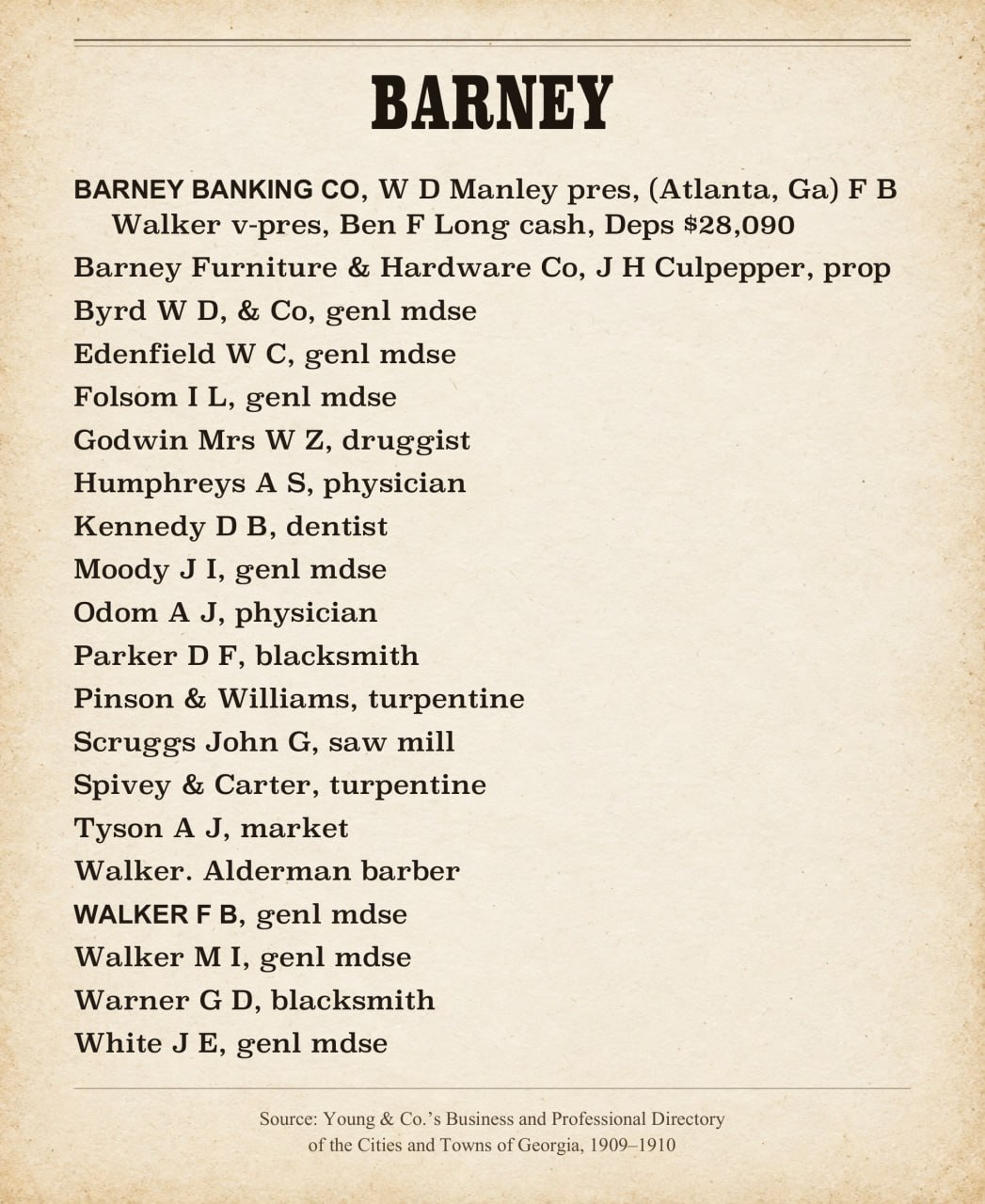
The directory treated Barney as each firm's business address; it did not establish that every operation stood inside the town limits. Contemporary newspapers place Pinson & Williams's turpentine and convict camps in southeastern Colquitt County, although the partnership used Barney as its address. The roster also records names and occupations rather than proving property ownership.
Early Stores and Commercial Development
On September 27 and 28, 1906, the Macon Telegraph and Valdosta Daily Times reported a fire at Walker & Moody's general-merchandise store. Fleming Bates Walker, identified in the reports as F. B. Walker, found the building filled with heat and smoke when he opened it at 6 a.m. Damage was estimated at about $1,500, most of it from smoke and water, and the cause was unknown.
On March 7, 1907, Sallie A. Rozier sold James I. Moody a storehouse and a 30-by-100-foot lot at the southwest corner of Main Street and First Avenue for $300. The warranty deed places Moody's store in Land Lot 320, directly south of Main Street.
Family history says Moody first came to Barney as a teenager to work in the general store of his uncle, F. B. Walker, and later bought a store building across the street. The public record is consistent with that broad outline: the firm name Walker & Moody appeared in 1906 newspaper reports, and later deeds place Walker's two brick storehouses across Main Street in Land Lot 321. The 1900 census, however, still recorded nineteen-year-old Moody in his family's Fodie household. It does not establish when he began working in Barney or when he moved there, so those details remain family history rather than a documented chronology.
On November 1, 1907, Moody bought a second parcel from Rozier for $125. The 175-by-155-foot lot lay immediately west of his store property along Main Street. Family and local history identify it as the site of Moody's residence. The deed describes the land and its boundaries but does not mention an existing house, building, or other improvement.
On April 24, 1908, the Valdosta Daily Times, reprinting the Adel News, reported that P. Feingold's frame dry-goods store at Barney had burned at about 2:30 Monday morning, apparently April 20. Feingold, an Adel merchant, had opened the store about two weeks earlier and was reportedly doing good business. Mr. Harris discovered the fire after the building's interior was already ablaze. The stock was valued at approximately $2,400, with about $2,000 in insurance through a company represented by T. M. Holland of Adel. The cause was unknown.
Young & Co.'s 1909–1910 Georgia business directory later listed “Feingold P” under clothing and dry goods in Adel and T. M. Holland as an Adel insurance agent. The directory confirms their occupations and Adel connection after the fire.
Banking and land promotion
The Atlanta Journal reported on September 24, 1905, that Citizens Bank had been organized at Adel with $25,000 in capital and planned a branch at Barney. The announcement does not prove that the proposed branch opened.
Two months later, on November 24, F. B. Walker carved a 30-by-100-foot bank parcel out of his own storehouse lot and conveyed it to Citizens Bank of Adel. Its description began on a north–south street, 90 feet north of an original land-lot line, then ran north 30 feet and west 100 feet. Compared with Barney's later street names and the surviving bank building, those calls place the bank on the west side of First Avenue, north of Main Street. The deed itself does not name either street.
A Bank of Barney was operating by June 25, 1906, when the Atlanta Georgian listed its representative among those expected at a meeting of banks associated with W. S. Witham. The paper printed the representative's initials as B. L. Long. On September 27, the same newspaper identified Ben F. Long as cashier of a bank at Barney.
On November 18, 1908, Citizens Bank of Adel conveyed the same 30-by-100-foot parcel to Barney Banking Company for $3,432.08. The deed identifies W. D. Manley as proprietor of the Barney company. It was recorded on January 12, 1909, in Deed Book T, pages 46–47. A December 1908 town profile independently confirms that Barney then had an operating bank and a brick bank building.
In February 1909, The Bankers Magazine reported, “Barney—Bank of Barney; title changed to Barney Banking Co.” A 1909–1910 Georgia business directory named W. D. Manley as president, Fleming Bates Walker as vice-president, and B. F. Long as cashier, and reported deposits of $28,090.
The 1910 census also recorded thirty-year-old Benjamin F. Long as a boarder in Mary Walker's First Avenue household and listed his occupation as “cashier” in a bank. In a small bank of that period, cashier was a senior operating position rather than a modern checkout-clerk job. The cashier commonly managed the daily receipt and payment of funds, accounts, notes, records, and correspondence under the president and directors. The census confirms Long's title but does not define his individual duties. In August 1911, the Dawson News reported that Clyde Newman had resigned from the Bank of Barney, showing that the older name remained in ordinary use after the reported title change.
The property deeds establish a Citizens Bank–to–Barney Banking Company chain for the bank lot. They do not fully explain how that chain related to the 1906 operating name Bank of Barney or to a Bank of Adel branch described in later testimony. Both Bank of Barney and Barney Banking Company continued to appear in later records.
Advertisements in September 1910 promoted farms in and around the Barney district. One listed land less than a quarter mile from Barney's businesses, churches, and schoolhouse. Another promoted Brooks County roads, schools, bridges, tax rates, rising land values, and farms near Barney. These advertisements document the sales pitch used for the area, not an independent assessment of those claims.
Sources
- The Valdosta Times, August 4, 1903, page 5, Brooks County tax-return report reprinted from the Quitman Free Press.
- The Valdosta Daily Times, 1905-1906, Barney & Smith coverage involving Milltown, Naylor, and Valdosta.
- The Valdosta Daily Times, October 4, 1906, page 4, "Surveys Are All Complete."
- The Valdosta Daily Times, November 29, 1909, Edward C. Bridges obituary.
- The Atlanta Journal, March 27, 1910, Brooks County profile.
- The Valdosta Daily Times, August 13, 1909, page 3, "First Bale of Sea Island."
- Moultrie Observer, December 9, 1904, page 7, notice identifying H. D. Woolard as a naval-stores operator of Barney, Moultrie-Colquitt County Library System.
- The Valdosta Daily Times, December 16, 1908, page 5, "Barney Wants to Reach Us"; weekly reprint in The Valdosta Times, December 19, 1908, page 5, Georgia Historic Newspapers.
- R. D. Flippen, Map of Brooks County, Georgia (Hudgins Co., 1908), Georgia Archives County Maps, record cmf0526.
- Sallie A. Rozier and John Berryhill to Spivey & Nesmith, warranty deeds, January 4 and December 3, 1907, Brooks County Deed Book S, page 272, FamilySearch.
- J. F. Spivey to W. P. Carter, warranty deed, August 15, 1908, Brooks County Deed Book S, page 566, identifying the Spivey & Nesmith turpentine-still tract, FamilySearch.
- Spivey & Carter to Southern States Naval Stores Company, security deed, December 22, 1910, Brooks County Deed Book U, pages 487–490, FamilySearch (continued; continued).
- Brooks County Deed Book M, pages 160–161, Celia A. Davis to African Methodist Episcopal Church trustees, February 25, 1896, FamilySearch original image; grantee-index entry for African Methodist Episcopal Church trustees to Jordan Baker, executed November 22, 1899, recorded in Deed Book 33, page 108, FamilySearch index image. The later original deed was not available in the inspected FamilySearch collection.
- Brooks County Deed Book N, page 35, Ancil Lawrence to William McCoy, November 1897, FamilySearch original image; Deed Book N, page 371, C. H. Berryhill to J. R. Anderson, 1897, FamilySearch original image.
- Brooks County Deed Book N, page 415, Ancil Lawrence to W. H. B. Spell, October 1899, FamilySearch original image; Deed Book O, page 376, W. H. B. Spell to Ada Smith, 1901, FamilySearch original image; Deed Book U, pages 463–464, Frank and Ada Smith to E. B. Thompson and Thompson to I. L. Folsom, 1906, FamilySearch original image.
- Brooks County Deed Book Q, pages 101–102, W. C. Edenfield to Mary Byrd, 1903, first image and second image; Deed Book S, page 290, I. L. Folsom to Mary Byrd, 1907, FamilySearch original image; Deed Book T, page 326, Mary Byrd to I. L. Folsom, 1909, FamilySearch original image; Deed Book U, page 281, Mary Byrd to C. H. Byrd, 1910, FamilySearch original image; Deed Book U, page 473, I. L. Folsom to J. J. Joyce, 1910, FamilySearch original image.
- “Barney, Ga., Dec. 16,” Valdosta Daily Times, December 16, 1908, page 5, Newspapers.com image 889673808.
- Advertisement for fifty business and residence lots in the Edgewood Addition, Valdosta Times, January 14, 1911, page 6, Newspapers.com image 889668366. The advertisement says ten residences and three brick stores were built in Barney in 1910; it does not identify the three stores as Edgewood property or assign them to numbered business lots.
- The Macon Telegraph, September 27, 1906, page 6, "Found Store on Fire When Doors Were Opened."
- The Valdosta Daily Times, September 28, 1906, "A Fire at Barney."
- Sallie A. Rozier to James I. Moody, warranty deed, March 7, 1907, Brooks County Deed Book S, page 13, FamilySearch.
- Sallie A. Rozier to James I. Moody, warranty deed, November 1, 1907, Brooks County Deed Book T, page 41, FamilySearch.
- 1900 United States census, Brooks County, Georgia, Fodie district, Moody household.
- Family oral history concerning James I. Moody and Fleming Bates Walker.
- F. B. Walker to R. T. Collins, warranty deed, May 3, 1915, Brooks County Deed Book Y, page 392, FamilySearch.
- The Valdosta Daily Times, April 24, 1908, page 7, "A Fire at Barney," reprinting the Adel News, Newspapers.com image 889736814.
- The Atlanta Journal, September 24, 1905, page 2, notice of Citizens Bank's organization and proposed Barney branch.
- F. B. Walker to Citizens Bank of Adel, and Citizens Bank of Adel to Barney Banking Company, warranty deeds, November 24, 1905, and November 18, 1908, Brooks County Deed Book T, pages 46–47, FamilySearch.
- Atlanta Georgian, June 25, 1906, second edition, page 5, Bank of Barney representative listed for the Witham bankers' meeting, Georgia Historic Newspapers.
- Atlanta Georgian, September 27, 1906, second edition, page 2, notice identifying Ben F. Long as cashier of a bank at Barney, Georgia Historic Newspapers.
- The Bankers Magazine, volume 78, number 2 (February 1909), page 356, notice of the title change to Barney Banking Company, Internet Archive.
- Young & Co.'s Business and Professional Directory of Georgia, 1909-1910, Barney and Adel entries, Digital Library of Georgia.
- 1910 United States census, Barney District, Brooks County, Georgia, household 22, Benjamin F. Long; household transcription.
- Dawson News, August 2, 1911, page 3, notice of Clyde Newman's resignation from the Bank of Barney, GenealogyBank.
- The Valdosta Daily Times, September 3, 1910, page 6, homeseeker advertisement listing Barney district farms.
- The Valdosta Times, September 24, 1910, page 12, Frank L. and John E. Gibson, "Bargains in Brooks County Farms." Back to the First Municipal Years overview