
Mount Zion
Mount Zion Camp Ground stood beside the Hall settlement north of present Morven. It served as a Methodist campground, church site, and burying ground for families in the Coffee Road neighborhood.
The site began at the western edge of Land Lot 271, in the same Coffee Road neighborhood as Sion Hall's home and Hamilton W. Sharpe's store. A 1908 Brooks County map labels the place “Camp Ground / Mt. Zion” and shows roads connecting it with Morven.
The first meetings
Hamilton W. Sharpe's 1884 participant account dated the first meeting to fall 1829; Folks Huxford and the later historical marker give 1828. Sharpe named the first tenters as William Blair, William Hendry, John Hendry, Rev. Joshua Platt, Hamilton W. Sharpe, John Pike, and Lawrence Folsom.
A centennial history published in 1926 adds another version without resolving the date. F. H. Edmondson wrote that the precise year of the church's establishment was unknown and credited Hamilton Sharpe and Henry Blair with beginning the place of worship. The celebration treated 1926 as the centennial year, which points to 1826, but Edmondson cautioned that minor details in the history might be inaccurate. J. B. Harrington separately placed the beginning of regular camp meetings between 1835 and 1840. These accounts may describe different stages in Mount Zion's development, but they do not establish a single first-meeting date.
The deed and trustees
On November 8, 1831, Sion and Enoch Hall conveyed about six acres associated with the camps, church, and burying ground to Methodist trustees William Blair, William Hendry, Lawrence Folsom, James J. Joyce, and William G. Hall. The title was to revert if religious use ended. Huxford copied the deed before the courthouse recording was lost. An 1833 Georgia act separately incorporated a Mount Zion trustee board, directly confirming William Blair and William Hendry in that role.
James J. Joyce was a Methodist minister, trustee, landholder, tax collector, and Court of Ordinary justice. Platt was a local Methodist preacher; no record found identifies him as an itinerant circuit rider. William Hendry was a grand juror and owned District 12 land near Mule Creek. No original record states that John and William Hendry were brothers, although the traditional relationship is strong probable.
From campground to church
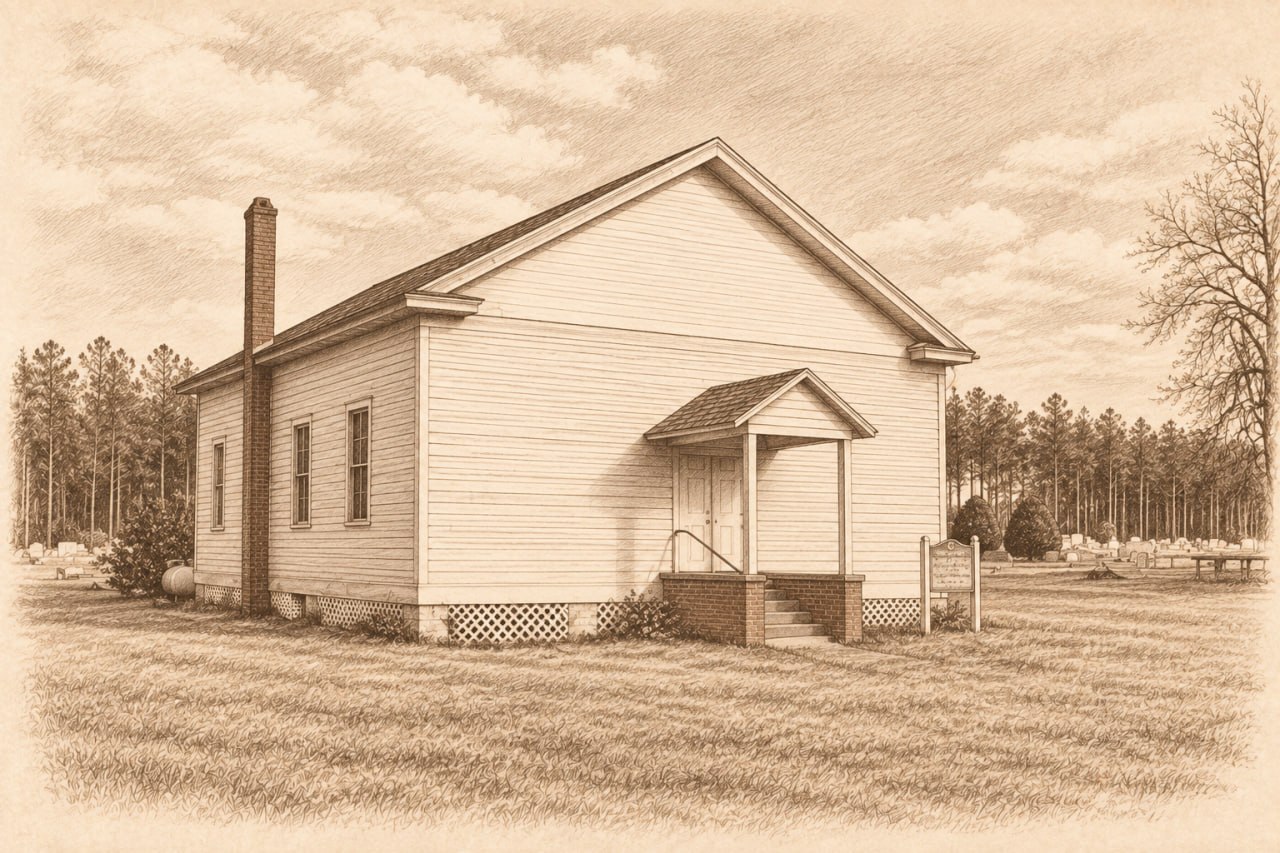
The 1926 history says the first permanent house of worship was a rough-log structure erected sometime between 1825 and 1830. It burned before 1856. Harrington wrote that the last arbor, built about 1845, was a roughly 100-by-100-foot, hip-roofed structure with rough seats and a preaching stand. It occupied the site of the later church.
According to Harrington, a new church was erected in 1856. William “Bill” Folsom and Moses Smith were major donors; George Brown and a brother-in-law of Billy Hatchett were the builders; and men identified as Asbell and Pedzic hewed timbers that local mills could not supply. A. T. Cook and B. P. Harrington remodeled the building in 1882. Charles Jones moved it nearer the road in 1920, when additional cemetery ground was needed. These details were recorded seventy years or more after the construction and should be read as local recollection. They replace the former summary's unsupported sequence of an open-air frame building about 1850 followed by a postwar replacement.
The same article remembered fifteen family tents. Along the north side were the Sharpe or preachers' tent and the King, McCoy, Morrow, and Peacock tents. A north-south row held the Riddick and Lawson tents and one associated with Dr. Hitch. Along the south line were tents associated with William Bradford; Dixon and Beasley; and the Campbell, Hendry, Martin, Folsom, and Ryalls families.
A contemporary account in the October 17, 1874, Independent confirms that a large camp meeting was still being held at Mount Zion.
The retrospective accounts disagree about when the campground period ended. Huxford said annual meetings continued through 1881, when the campground arrangement ended and a church was organized. The 1926 history placed the abandonment of the camping ground about 1888 and attributed it to disruptive visitors and the deteriorated tents and arbor. The later South Georgia Conference history dates the congregation's organization to 1881 and places Mount Zion on the Morven Circuit. That history reports that seventeen Mount Zion members transferred when the Barney church was built.
The 1926 history also says Bethlehem Church was organized near the old Campbell place, about a mile south of Morven, in the late 1830s. Many people who camped and attended services at Mount Zion were said to have been Bethlehem members.
Camp Ground Cemetery
The burial ground survives as Camp Ground Cemetery at Mount Zion Church. Cemetery compilations and surviving grave markers document its continued use, although no official burial register has been located.
Sources
- Hamilton W. Sharpe, “History of Lowndes County,” The Valdosta Times, 1884 series.
- Folks Huxford, History of Lowndes County, Georgia, 1825-1941, including his transcription of the November 8, 1831 Mount Zion deed before the courthouse copy was lost.
- Acts of the General Assembly of Georgia, 1833, incorporating the Mount Zion trustees.
- Independent, October 17, 1874, contemporary account of the Mount Zion camp meeting, reprinted by Huxford.
- Brooks County map, 1908, showing “Camp Ground / Mt. Zion” and the road to Morven.
- F. H. Edmondson and J. B. Harrington, Mount Zion centennial history, Valdosta Daily Times, June 2, 1926, p. 2, Newspapers.com image 889447436.
- Marynell S. Waite, ed., History of the South Georgia Conference, The United Methodist Church, 1866-1984, Mount Zion and Barney church histories.
- Camp Ground Cemetery compilations and surviving grave-marker photographs; no official burial register has been located.
- The evidence-graded profiles for Sion Hall, Enoch Hall, William Blair, William Hendry, John Hendry, Joshua Platt, John Pike, James J. Joyce, and Lawrence Folsom.