
William Folsom of old Irwin, Lowndes, and Brooks counties, Georgia
Back to the Early History Profiles index
Evidence-graded online dossier
Subject: William Folsom, early South Georgia settler and son of Lawrence Folsom
Life dates: born about 1795 in Georgia; died November 16, 1872, at his Brooks County residence
Prepared: August 19, 2026
Updated: October 2, 2026
Standard: Original records and contemporary newspapers control. Later county histories, compiled genealogies, collaborative trees, and cemetery pages are identified as such. Repetition among derivative sources is not treated as independent proof.
Bottom line
William Folsom was an early Irwin County resident who remained in the same general South Georgia neighborhood as county boundaries changed from Irwin to Lowndes and then Brooks. Later courthouse-based histories identify a William Folsom on Irwin County courthouse-and-jail commissions in 1823 and 1825. A published transcription of an 1845 Lowndes grand-jury list also names William Folsom, and Brooks County's first petit-jury list in 1859 includes the name. Age and location make the subject a plausible to strong-probable match in these civic records, but the records as reviewed do not identify his wife, parent, or land.[1–4]
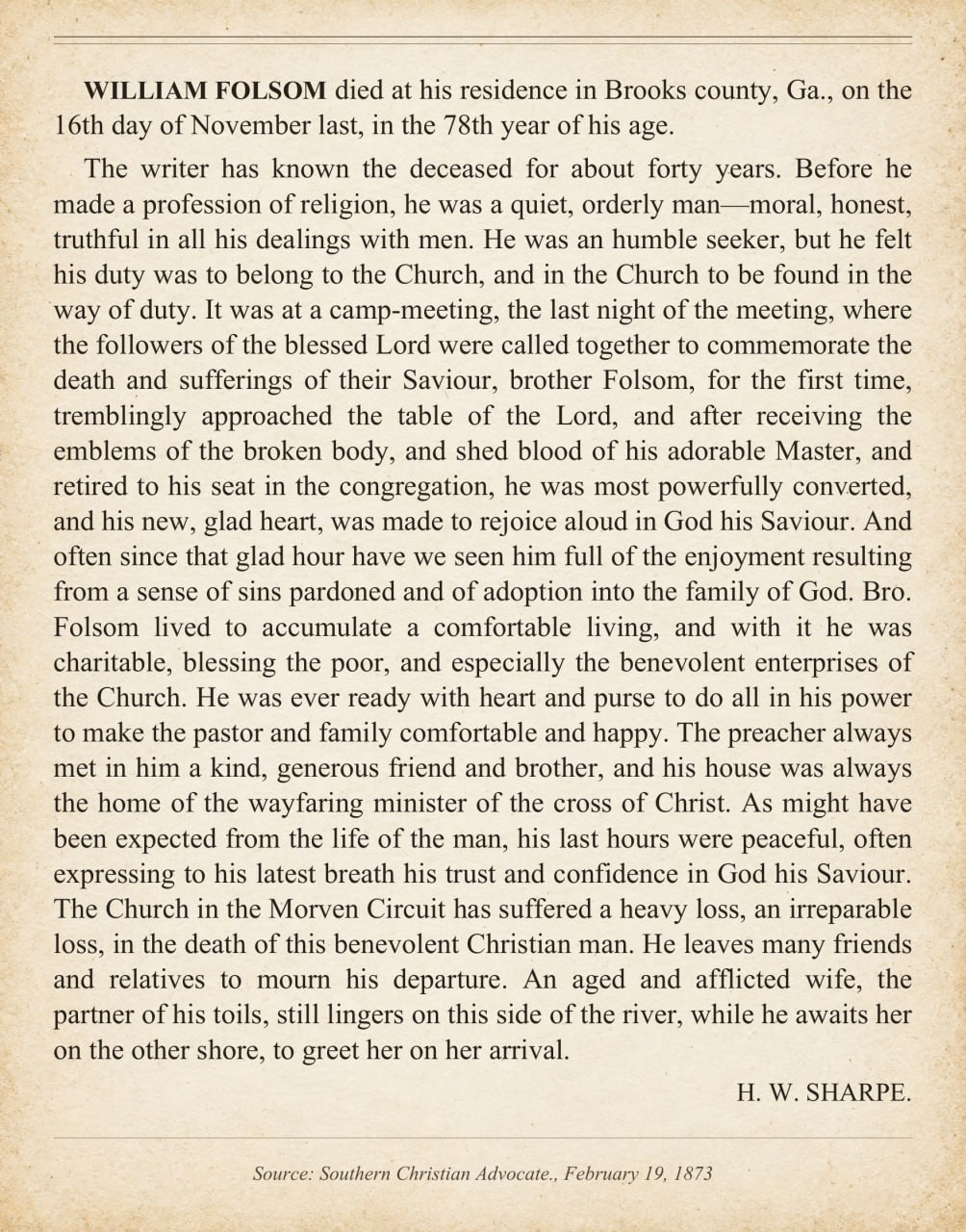
His death is unusually well documented. In an obituary he wrote for William Folsom, Hamilton W. Sharpe states that Folsom died at his Brooks County residence on November 16, 1872, in his seventy-eighth year. It describes a long-established Methodist, generous to poor people, ministers, and church causes, and says that an aged wife survived him. The complete original page appeared in the Southern Christian Advocate on February 19, 1873.[5][6]
The family structure is clearer than earlier compilations suggested, but it is not complete. FamilySearch's Pulaski County marriage record/index reports William's 1813 marriage to Elizabeth Folsom. Elizabeth's 1876 will directly calls Edith Rountree and Nancy Bradford her daughters; identifies W. R., C. W., A. C., and Ruth Ann Ryall as her grandchildren and the children of Rachel Ann Ryall; and names C. W. Ryall and William Harrell as grandsons.[7–10][34][35]
Contrary to online reports, William and Elizabeth were not buried in unmarked graves in their family cemetery, but in marked graves on their homeplace in Land Lot 520, District 9. The surviving stone is broken and weathered, but both names are visible. William's panel preserves the year 1872; Elizabeth's preserves 1877. The smaller date lines are not clear enough for a full independent transcription.[36][37]
Administration of William's Brooks County estate was secured by a $30,000 bond. William R. Ryall and Charles W. Ryall served as administrators, with West Rountree, Green Lawson, and Nicholas M. Reddick as sureties. Four administrator's deeds prove that William died owning at least 2,080 acres: all of Land Lots 492, 519, and 521 in District 9; 120 acres in the southeast corner of Lot 491 in District 9; and all of Lot 323 in District 12. The estate sold those tracts to Nancy Perry, Charles W. Ryall, and West Rountree. A newly reviewed acquisition deed proves that James Bond conveyed all of LL 519/9 to William for $100 in 1855. Elizabeth's executor later conveyed her Land Lots 493 and 520 in District 9 to her daughter Edith Rountree. These deeds document a Folsom-Ryall-Rountree-Perry land network north of Barney, although William's remaining acquisition deeds and the later Rountree-to-J. E. Moody chain remain unlocated or unreviewed.[11–13][38–43]
Identity and chronology
This dossier concerns the William Folsom born in Georgia about 1795, living in old Lowndes County by 1850, in Brooks County after its 1858 creation, and dying there in 1872. His age, wife Elizabeth, neighborhood, associates, 1870 household, obituary, and probate form a coherent identity chain.[5][9][14–16]
He must not be merged with Lieutenant William Folsom of Revolutionary-era Burke County; William I. Folsom, a younger Brooks County Confederate soldier; later judges or lawyers of the same name; William Folsom Ryall; or William Folsom Harrell. The surname cluster is dense, and title or location alone is not enough to transfer a record from one man to another.[7][10]
| Date | Event | Evidence judgment |
|---|---|---|
| about 1795 | Born in Georgia; Burke County is a compiled-family-history claim | Verified for Georgia and strongly supported for approximate year from census/obituary; secondary-supported for Burke County |
| Dec. 11, 1813 | Married Elizabeth Folsom in Pulaski County | Strong indexed record evidence; FamilySearch county-marriage record/index |
| Dec. 13, 1823 | A William Folsom named on an Irwin courthouse-and-jail commission, according to later courthouse-based history | Possible to strong probable identity; original act page still required |
| Dec. 24, 1825 | A William Folsom named on the replacement Irwin county-site commission | Possible to strong probable identity; original act page still required |
| 1845 | William Folsom named on a Lowndes grand-jury list | Strong secondary transcription; original newspaper page not independently inspected |
| 1850 | Lowndes County household with Elizabeth and younger household members | Verified census evidence |
| 1859 | William Folsom appears among Brooks County's first petit jurors | Strong compiled official evidence; same-man identity strong probable |
| 1860 | Brooks County schedule attributes one enslaved eleven-year-old boy and one slave house to Wm. Folsom | Strong transcription evidence; original image needed |
| 1870 | Brooks County dwelling with Elizabeth, William Harrill, Dicy Roberts, Louis Roberts, and John Roberts | Verified census evidence |
| Nov. 16, 1872 | Died at his Brooks County residence, in his seventy-eighth year | Verified by contemporary obituary |
| July 7, 1873 | $30,000 administration bond executed | Verified manuscript |
| Aug.–Sept. 1873 | Administrators sold beef cattle and sought leave to sell land for the heirs | Verified contemporary notices |
| Dec. 1873–Jan. 1874 | Estate auctions transferred William's Brooks County lands to Nancy Perry, Charles W. Ryall, and West Rountree | Verified original deeds |
| Apr.–Nov. 1874 | Administrators executed deeds for LLs 492, 519, 521, part of 491, and LL 323 | Verified original deeds |
| Feb. 5, 1878 | Elizabeth's executor conveyed LLs 493 and 520/9 to her daughter Edith Rountree for $1,200 | Verified original deed and will |
Birth, parents, and migration
The obituary places William in his seventy-eighth year at death, implying birth between November 17, 1794, and November 16, 1795. The 1870 census gives age seventy-five, also pointing to about 1794–1795. The frequently repeated year 1797 comes from later genealogy and cemetery/tree profiles, not from a contemporary birth record. A publication-safe birth statement is about 1795 in Georgia. Burke County remains plausible but unproved.[5][7–10][16]
The 1938 Genealogy of the Folsom Family calls him the son of Lawrence Armstrong Folsom and Rachel Vickers. That Georgia section openly depends on family informants, principally Mrs. Boyd and Horace B. Folsom. FamilySearch, WikiTree, Find a Grave, and other online trees repeat the relationship. Contemporary 1849–1850 legal notices add important independent support: a William Folsom acted as executor of Lawrence Folsom's Lowndes County estate, sought leave to sell its enslaved people, and advertised estate property at James Folsom's house. The notices do not call William Lawrence's son, and the original will or probate file was not located. The executor's identity with this subject is strong probable from name, county, chronology, and family context; Lawrence and Rachel as his parents remain strong probable, not directly verified.[7–10][17][28][29]
William's migration has often been told too simply. Mrs. D. H. Purvis wrote in 1948 that he moved from Irwin County into the later Barney district in the 1830s. Yet the courthouse-commission traditions already place a William Folsom in Irwin civic affairs in 1823 and 1825, and the family genealogy assigns several children to Lowndes County before or during the 1830s. The surviving evidence supports continuous residence in the broader Irwin-to-Lowndes region, but it does not supply one exact arrival date at the later Brooks plantation.[1–3][7][18]
Public and community roles
Irwin County courthouse commissions
Folks Huxford's county history and his 1950 newspaper history say the General Assembly first appointed William Folsom, James Crum, Silloway McCall, Joshua Griffin, and Alexander McDonald as Irwin courthouse-and-jail commissioners on December 13, 1823. They apparently did not complete the work. The December 24, 1825 organizing act then named John B. F. Dixon, James Wilcox, Emanuel Knowles, William Folsom, and Elijah Beasley as replacement Irwin commissioners.[1–3]
Huxford distinguishes the 1825 Irwin appointment from the simultaneous Lawrence Folsom commission for newly created Lowndes County. The two names should not be merged: his account puts Lawrence on the Lowndes commission and William on the Irwin commission. The target William was old enough and geographically plausible, and the repeated name in the two Irwin appointments supports a single local man. Neither the original act pages nor an identifying residence, relative, or tract was recovered, however. The subject's service is therefore possible to strong probable, not verified.[1–3][30]
Jury service
A published transcription of a June 1845 Lowndes Superior Court report names William Folsom among the grand jurors at Troupville. The transcription is strong secondary evidence, but the underlying newspaper image was not independently inspected in this project. Even if the reading is correct, the report establishes only jury service, not foremanship, office, party, or a specific verdict.[4]
Huxford's transcription of Brooks County's first jury lists names William Folsom as petit juror number forty in 1859. Age, location, and prominence make the pioneer the strong-probable identity, but the list itself provides no age or residence. No record found online makes him a judge, justice of the peace, sheriff, legislator, militia officer, road commissioner, or elected county officer.[1]
Wife and children
Elizabeth Folsom
FamilySearch's Pulaski County marriage record/index reports William and Elizabeth Folsom's marriage on December 11, 1813. Their 1850 and 1870 households and the 1873 obituary continue the identity chain and establish that Elizabeth survived William. The 1938 genealogy identifies her as a distant Folsom cousin, daughter of George Folsom and Edith Penny. No inspected birth, Bible, or parent-naming record proves that ancestry.[5][7][9][14][16][34]
Elizabeth executed her will on January 28, 1876, and it was recorded August 13, 1877, disproving the genealogy's statement that she died about 1875. A memorial gives March 16, 1877. The newly supplied monument photograph visibly supports 1877, but damage and weathering prevent a confident reading of the smaller month-and-day line from this image alone. Judgment: Elizabeth as William's wife is verified, and the 1813 marriage date has strong indexed record evidence. Her George/Edith parentage is strong compiled tradition. Her death year is now verified by the photographed monument; March 16 remains probable but not independently verified from the image.[7][34–36]
Publication-safe child structure
The 1938 genealogy lists eight children. The list is useful, but it is not an heir return and should not be called complete or proved merely because modern trees copy it.[7]
- Green Folsom: said to have died as a small boy. Compiled-family-history only. FamilySearch's Green profile points to different preferred parents, a material conflict.
- Rachel Ann Folsom Ryall: Elizabeth's will identifies W. R., C. W., A. C., and Ruth Ann Ryall as her grandchildren and as Rachel Ann Ryall's children. The 1938 genealogy explicitly calls Rachel a daughter of William and Elizabeth, and the Ryall sons' later administration of William's estate reinforces the relationship. Because the will does not use the exact phrase “my daughter Rachel Ann,” the conservative grade is strong probable, bordering verified.[7][11][19][35]
- Edith Folsom Rountree: Elizabeth's will directly calls Edith her daughter and the wife of West Rountree. William and Elizabeth appear as a married couple across the census chain, with no evidence of stepchildren or another marriage. Verified daughter of Elizabeth; strong-probable daughter of William.[7][11][20][35]
- George Folsom: listed in the genealogy, but nearby men of the same name create serious confusion. The 1860 slave schedule has a separate George entry. Possible/compiled; identity and child structure unresolved.[7][21]
- Nancy Folsom Perry Bradford: Elizabeth's will directly calls Nancy Bradford her daughter and the wife of John Bradford. The 1938 genealogy says Nancy first married a Perry, while descendant material reports a later Andrew Jackson Bradford marriage dated after the will was executed. Verified daughter of Elizabeth; strong-probable daughter of William. The Perry/Bradford spouse chronology and the will's “John Bradford” wording remain unresolved.[7][9][35]
- Martha Folsom Harrell/Horrell: an 1892 obituary for John S. Harrell calls his late wife Martha the “youngest daughter of William Folsom, Esq.” That explicit statement, published twenty years after William's death, joins the compiled genealogy, Martha's placement in William's 1850 household, Elizabeth's identification of William Harrell as a grandson, and the younger William Harrill's presence in William's 1870 dwelling. Strong probable daughter and likely youngest daughter; the article does not identify her mother. Later sources conflict between 1861 and 1895 death dates; Elizabeth's 1876 will is consistent with an earlier death but does not prove 1861.[7][14][16][22][31][35]
- Hardy Vickers Folsom: Hardy appears in William and Elizabeth's 1850 household; the genealogy identifies him as a son, and a Brooks County marriage record links Hardy V. Folsom and Tempy Ann Wells in 1859. Strong probable son; the census does not state relationships.[7][9][14]
- Janie/Jane Folsom: the genealogy says James Perry's wife; FamilySearch repeats the marriage but attaches no source. Possible daughter / tree-and-genealogy claim.[7][9]
FamilySearch adds Noah Folsom, born about 1832, as another son and identifies Julia Drawdy as his wife. Noah belongs to the same local Folsom cluster, but no record found in this research names William and Elizabeth as his parents. He is therefore a possible additional son, not a ninth verified child.[9][10]
Farming, land, livestock, and wealth
The 1948 Barney history portrays “Uncle Billy” as a prominent planter near Little River who produced brown sugar for Savannah and Tallahassee and sent large cattle herds to Savannah and Charleston. It says his land later became the Rountree place owned by J. E. Moody. Sharpe's obituary independently supports a comfortable living and generous use of wealth, while the 1873 cattle notice proves that the estate owned beef cattle in Colquitt County. These points give the later account a real economic foundation, but they do not verify every production figure or annual cattle-drive claim.[5][12][18]
Four original administrator's deeds replace much of the earlier derivative land picture. William died seized and possessed of all of District 9 Land Lots 492, 519, and 521; 120 acres in the southeast corner of Lot 491; and all of District 12 Land Lot 323. The sales produced $800 from Nancy Perry for LL 492, $640 from Charles W. Ryall for LL 519 and the 120-acre portion of LL 491, $837 from West Rountree for LL 521, and $125 from West Rountree for LL 323. These deeds prove at least 2,080 acres in William's estate. They do not establish that this was his complete landholding.[38–41]
One acquisition deed is now verified. On May 18, 1855, James Bond of Dougherty County conveyed William Folsom of Lowndes County all 490 acres of Land Lot 519 in the 9th District, originally Irwin and then Lowndes County, for $100. The deed was not recorded in Brooks County until June 5, 1891, in Deed Book K, pages 267–268. That delayed recording explains why the acquisition appeared beside the 1874 estate conveyance rather than in a contemporary Brooks deed book.[43]
The Brooks grantee index also points to a warranty deed from W. H. Price to William Folsom for all 490 acres of LL 492/9, dated October 11, 1826, and recorded November 17, 1911, in Deed Book U, page 377. That index entry fits the tract later sold from William's estate, but the complete deed has not yet been reviewed. Its consideration and title language remain unproved.[44]
Elizabeth's will and executor's deed add two whole District 9 lots to the family cluster. On February 5, 1878, Charles W. Ryall, acting under Elizabeth's will, conveyed LLs 493 and 520 to her daughter Edith Rountree for $1,200. The deed does not state that William had owned those two lots. It proves Elizabeth's title and the transfer to Edith.[35][42]
A derivative tax/land KML also assigns William Lot 493 and Lot 520, plus Lot 322 in District 12, and reports acreage totals that do not reconcile cleanly. The deeds now verify much of the District 9 cluster, but not William's title to 493 or 520, and not Lot 322. The original tax pages remain necessary for those claims.[23][38–42]
Geographic judgment: William's estate and Elizabeth's adjoining property formed a documented District 9 cluster north of Barney: Lots 491–493 and 519–521. The estate also included LL 323/12. This land passed into the Perry, Ryall, and Rountree family network, and nine researched descendant paths reach identified 1900 Barney households. William's acquisition of LL 519 is now proved; the grantee index supplies a still-unreviewed acquisition reference for LL 492. The exact house site, acquisition history of the other tracts, LL 322, the later Moody title chain, and the legal cemetery parcel remain unresolved.[18][23][38–44]
Folsom Bridge
No located naming record identifies William as Folsom Bridge's namesake. Contemporary 1885 and 1893 evidence and early maps point instead to the older Lawrence–James–Andrew Jackson Folsom settlement at the east approach. William's reported plantation lay several miles west. The safest wording is that the bridge was named for the Folsom family settlement; Lawrence is the leading individual candidate, and William is geographically disfavored as the specific namesake.[24]
Enslaved people and the post-emancipation household
A public transcription of the 1860 Brooks County slave schedule lists Wm. Folsom with one enslaved male aged eleven and one slave house. A separate George Folsom entry lists ten enslaved people. The entries must not be combined. The original schedule image was not recovered in this pass, and no name can be assigned to the boy.[21]
The 1870 population schedule places three Black residents in William and Elizabeth's dwelling: Dicy Roberts, twenty-five, a domestic servant; Louis Roberts, four; and John Roberts, three. The census stated no relationships. In 1880, Dicea Roberts headed a Brooks County household with sons Lewis, fifteen, and John, fourteen, plus daughter Harriet, nine. The matching name forms, county, and ages verify postwar continuity for Dicy/Dicea and the two sons.[15][25]
Nothing in those records proves that Dicy had been enslaved by William. Her age and sex exclude her from the unidentified eleven-year-old boy; Louis and John were born after emancipation. Employment, housing, kinship, or some other association could explain the shared 1870 dwelling. No person has been identified responsibly across the slavery-to-freedom divide.
The contrast between the one-person 1860 schedule and Purvis's later “large plantation” worked by enslaved labor is unresolved. It may reflect different dates, hired labor, property held by relatives, earlier holdings, or exaggeration in the retrospective account. The evidence does not permit choosing among those explanations.[18][21]
Mount Zion and Methodist life
William was not among the seven original tenters named in Hamilton W. Sharpe's 1884 recollection, nor among the trustees in the 1831 Mount Zion deed. Lawrence Folsom held the trustee role. Sharpe did list William among deceased early residents of the Halls/Mount Zion neighborhood, and Purvis wrote in 1948 that “old settlers” credited William with doing more than anyone else toward the later church building.[18][26]
The obituary supplies the firmest personal evidence. Sharpe, who said he had known William about forty years, described William's conversion at a camp meeting, hospitality to traveling ministers, generosity to church causes and poor people, and standing in the Morven Circuit. This verifies long Methodist affiliation and support. It does not prove the later comparative claim that he contributed more than everyone else, a construction date, a payment amount, or a formal trustee office.[5]
Death and estate
The Southern Christian Advocate obituary states that William died at his Brooks County residence on November 16 “last,” in his seventy-eighth year. Because the issue is February 19, 1873, the year is 1872. Georgia Historic Newspapers supplies the complete original page, visibly numbered 28 and carrying the newspaper masthead and volume information. No numbered columns are printed. The writer was H. W. Sharpe.[5]
On July 7, 1873, William R. Ryall and Charles W. Ryall executed a $30,000 administration bond, with West Rountree, Green Lawson, and Nicholas M. Reddick as sureties. It was recorded August 12. The facing John Tillman bond is unrelated; Sharpe's signature on that facing page must not be attributed to William's estate.[11]
The notice printed August 23 advertised an estate beef-cattle sale at Moultrie. The September notice states that the administrators would seek leave to sell William's lands for the heirs. Later notices directed creditors to present claims and debtors to pay. In September 1875 the Ryalls represented that they had fully administered the estate and sought discharge on the first Monday in December; repeated citations document the closing stage, but no final discharge order was located.[11–13][32][33]
No online inventory, appraisal, sale return, heir list or receipts, final return, distribution, or discharge order was located. Four administrator's deeds were located and inspected. They identify the land, buyers, prices, Ordinary Court authority, auction dates, and conveyance dates, but they do not expressly call the buyers William's children or heirs.[11–13][32][33][38–41]
Elizabeth's later will supplies the kinship language missing from William's estate file. It directly identifies Edith and Nancy as her daughters, the four named Ryalls as her grandchildren and Rachel Ann's children, C. W. Ryall and William Harrell as grandsons, and Charles W. Ryall as executor. The will is powerful family evidence but is not a complete list of William's heirs or children.[35]
Burial and grave location
Find a Grave assigns William and Elizabeth to Old Folsom Family Cemetery near Hahira and describes the graves as unmarked. That description is wrong. A user-supplied photograph shows a broken marble monument inscribed for both William and Elizabeth Folsom. William's name and the year 1872 are visible on the upper panel; Elizabeth's name and the year 1877 are visible below. The photograph verifies that a named monument existed, though it does not by itself identify the cemetery or geographic location.[6][36]
The 1938 genealogy says they were buried on the old Folsom homestead. Field documentation places the marked graves in Land Lot 520, District 9, on the homeplace later associated with the Rountree and Moody families. The Find a Grave map instead places them in Lowndes District 12, Land Lot 187, while describing the graves as unmarked. The monument photograph and field identification contradict that entry. A survey, cemetery deed, or burial register has not been found, so the legal cemetery parcel and its relationship to the full plantation boundary remain unresolved.[6][7][18][36][37]
Claims graded
Verified or strongly supported
- William lived in the old Irwin/Lowndes/Brooks region and died at his Brooks County residence on November 16, 1872.[5][14–16]
- A surviving photograph verifies a broken marble monument bearing William and Elizabeth Folsom's names and their respective death years, 1872 and 1877.[36]
- FamilySearch's county-marriage record/index reports that William married Elizabeth Folsom in Pulaski County on December 11, 1813; the household and obituary evidence establish that she survived him.[5][14][16][34]
- A published transcription of an 1845 newspaper names William Folsom as a Lowndes grand juror; the subject's identity is strong probable.[4]
- Sharpe had known him for about forty years and described him as a generous Morven Circuit Methodist.[5]
- His estate included land and beef cattle; administration was secured by a $30,000 bond.[11–13]
- William R. and Charles W. Ryall administered the estate; West Rountree, Green Lawson, and Nicholas M. Reddick were sureties.[11]
- Original administrator's deeds prove William owned at least 2,080 acres: LLs 492, 519, and 521/9; 120 acres in the southeast corner of LL 491/9; and LL 323/12.[38–41]
- The administrators sold those lands to Nancy Perry, Charles W. Ryall, and West Rountree. Elizabeth's executor later conveyed LLs 493 and 520/9 to her daughter Edith Rountree.[35][38–42]
- Elizabeth's will directly identifies Edith Rountree and Nancy Bradford as her daughters and identifies the four named Ryalls and William Harrell as her grandchildren.[35]
- The 1870 dwelling included Dicy Roberts and her sons Louis and John, who continued together in 1880.[15][25]
Strong probable or secondary-supported
- Lawrence Folsom and Rachel Vickers were William's parents.[7–10]
- The William named on the 1823 and 1825 Irwin courthouse commissions was this man.[1–3][30]
- The William who executed Lawrence Folsom's estate was this subject.[28][29]
- Rachel Ann Ryall, Martha Harrell, and Hardy Vickers Folsom were William and Elizabeth's children; Edith Rountree and Nancy Bradford are verified daughters of Elizabeth and strong-probable daughters of William.[7][9][11][14][19][20][22][31][35]
Unresolved, unsupported, or contradicted
- Exact birth day/year, Burke County birthplace, and the full parent-naming chain.
- A complete and record-proved child list; Noah's parentage; the duplicated Edith/George tree profiles; Martha's exact death date.
- Any office as judge, legislator, justice, sheriff, militia officer, or road overseer.
- William's remaining acquisition deeds, complete plantation acreage, exact house site, complete heir list, LL 322, and the later Moody title chain.
- Whether William ever held title to LLs 493 and 520. The inspected deed proves Elizabeth owned and conveyed them; it does not recite William's prior ownership.[42]
- Sugar production and exceptional support of Mount Zion are retrospective local traditions; no contemporary production or church-finance record was located.[18][26]
- Identification of the unnamed boy enslaved in 1860 or any cross-emancipation identity.
- William as the specific namesake of Folsom Bridge.
- Elizabeth's exact death date; the smaller month-and-day inscription remains unreadable in the supplied photograph.
Online research coverage and limits
Local evidence collections, prior early-settlement reports, probate sources, road and bridge research, and saved newspaper datasets were searched first. Name variants included William Folsom, Wm. Folsom, William Folson, William Folsoom, Uncle Billy, Billy Folsom, and combinations with Lawrence, Elizabeth, Ryall/Ryals, Rountree/Roundtree, Harrell/Harrill, Roberts, Morven, Barney, Little River, Mount Zion, estate, heirs, land, cattle, jury, commissioner, and obituary.
Online checks covered authenticated Ancestry census/probate and obituary indexes, FamilySearch collaborative profiles and record pointers, Find a Grave images and cemetery pages, WikiTree, Internet Archive's Folsom genealogy, Georgia Historic Newspapers, Newspapers.com, Georgia Archives maps/land lots, Ray City History Blog, Wiregrass Region Digital History Project, and broad web searches. Logged-in or image-level access is stated where used. Search snippets and collaborative trees support leads only.
The following material was not found online: original birth record; Lawrence's will or probate file; original 1823 and 1825 act pages; 1820–1840 William-specific census chain; original 1850/1860 slave-schedule images; William's complete Brooks estate file; acquisition deeds for the remaining tracts; original tax pages; the land-sale return; heir receipts; Mount Zion local records; and a burial register, cemetery deed, or survey. One acquisition deed, four administrator's deeds, and Elizabeth's executor deed are now verified online. This dossier does not imply that undigitized courthouse and church records do not exist.
Best next archival work
- Obtain the original 1823 and 1825 Georgia acts naming Irwin commissioners and compare exact spelling, powers, and dates.
- Request William Folsom's complete Brooks County loose estate file and every inventory, appraisal, sale, annual/final return, voucher, distribution, and order/minute entry, 1872–1885.
- Open Deed Book U, page 377, to verify the indexed 1826 acquisition of LL 492, then search backward for the remaining acquisition deeds and forward from the verified Perry, Ryall, and Rountree conveyances to the later J. E. Moody title chain.
- Obtain original Lowndes/Brooks tax pages behind the reported 1869–1872 acreage and the original 1850 and 1860 slave schedules.
- Search Mount Zion/Morven Circuit trustee, membership, financial, cemetery, and burial records for William and Elizabeth.
- Locate a parent-naming record for each proposed child rather than relying on the compiled eight-child list.
Numbered sources
- Folks Huxford, The History of Brooks County, Georgia, 1858–1948 (Quitman, 1948/1949), especially pp. 13, 68–69, 276–279, and 387–389: https://hdl.handle.net/2027/uva.x000002988.
- Folks Huxford, Irwin organization history, Valdosta Daily Times, October 26, 1950, p. 8, Newspapers.com image
890281404: https://www.newspapers.com/image/890281404/. - Georgia General Assembly, act organizing Lowndes and replacing the Irwin county-site commissioners, approved December 24, 1825; reproduced/discussed in Huxford source 1 and source 2. Original act image remains an archival target.
- “Grand Jurors of 1845, Lowndes County, GA,” Ray City History Blog transcription and discussion of the June 1845 court list: https://raycityhistory.wordpress.com/2015/06/07/grand-jurors-of-1845-lowndes-county-ga/.
- H. W. Sharpe, William Folsom obituary, Southern Christian Advocate (Macon), February 19, 1873, p. 28, image 4, complete original page, Georgia Historic Newspapers: https://gahistoricnewspapers.galileo.usg.edu/lccn/sn91099152/1873-02-19/ed-1/seq-4/; OCR-bearing JSON record: https://gahistoricnewspapers.galileo.usg.edu/lccn/sn91099152/1873-02-19/ed-1/seq-4.json.
- Find a Grave memorial 157158604, attached derivative obituary crop 212273252 and memorial data: https://www.findagrave.com/memorial/157158604/william-folsom/photo; crop: https://images.findagrave.com/photos/2020/249/157158604_9d63be20-4261-483e-a045-9efdd07f33e2.jpeg.
- Elizabeth Knowles Folsom, Genealogy of the Folsom Family, rev. 1938, vol. 2, Georgia families, printed pp. 865–869: https://archive.org/details/genealogyoffolso02fols/page/866/mode/2up.
- WikiTree, William Folsom profile
Folsom-1436: https://www.wikitree.com/wiki/Folsom-1436. - FamilySearch collaborative profile, William Folsom
K244-WMQ, with spouse ElizabethK244-H59: https://www.familysearch.org/tree/person/details/K244-WMQ. - Conflict-aware descendant evidence audit recording the authenticated FamilySearch profile and source review; used with source 7 rather than as an independent original record.
- Georgia Court of Ordinary (Brooks County), William Folsom estate administration bond, July 7, 1873, recorded August 12, 1873; Ancestry collection 8635, record 243013, image
005782591_00363: https://www.ancestry.com/search/collections/8635/records/243013. - “Administrator's Sale,” The Independent (Quitman), August 23, 1873, p. 3/image 3: https://gahistoricnewspapers.galileo.usg.edu/lccn/sn89053564/1873-08-23/ed-1/seq-3/.
- Notice of application to sell William Folsom's land, The Independent (Quitman), September 13, 1873, p. 3/image 3: https://gahistoricnewspapers.galileo.usg.edu/lccn/sn89053564/1873-09-13/ed-1/seq-3/.
- 1850 U.S. census, Lowndes County, William Folsom household; FamilySearch record pointer associated with William/Elizabeth profiles and Martha Folsom pointer
MZYY-KJP: https://www.familysearch.org/ark:/61903/1:1:MZYY-KJP. - 1870 U.S. census, Brooks County, William Folsom household; Ancestry collection 7163, record 588007, image
4263363_00137: https://www.ancestry.com/search/collections/7163/records/588007. - 1870 U.S. census, Dicy Roberts entry in William Folsom's dwelling; Ancestry collection 7163, record 13952866, same image: https://www.ancestry.com/search/collections/7163/records/13952866.
- Lawrence Folsom evidence-graded research dossier, including parentage and probate limits.
- Mrs. D. H. Purvis, “Barney,” in Huxford, source 1, printed pp. 387–389.
- Find a Grave memorial 242369400, Rachel Ann Folsom Ryall; derivative parent statement, not a parent-naming original record: https://www.findagrave.com/memorial/242369400/rachel-ann-ryall.
- Ray City History Blog, James Rountree and Edith Folsom family discussion: https://raycityhistory.wordpress.com/2018/05/05/james-rountree-1787-1834-pioneer-settler-of-old-lowndes/.
- Georgia Genealogy Trails, public transcription of the 1860 Brooks County slave schedule; Wm. and George Folsom entries. Original image remains required: https://genealogytrails.com/geo/brooks/1860slave1.html.
- WikiTree, William Folsom Harrell profile
Harrell-3431, with FamilySearch record pointers: https://www.wikitree.com/wiki/Harrell-3431. - Public Google My Maps KML, “Circa 1870. Old Irwin,” William Folsom placemark and tax/land-lot transcription, derivative index: https://www.google.com/maps/d/kml?mid=1uAP1zA0ExqRb01-n1PrZCuaiQDo&forcekml=1.
- Folsom Bridge land and name evidence report, with original deed, newspaper, and map citations.
- 1880 U.S. census, Dicea Roberts household, Brooks County; Ancestry collection 6742, record 7465796, image
4240127-00295: https://www.ancestry.com/search/collections/6742/records/7465796. - Hamilton W. Sharpe, Mount Zion and Halls neighborhood recollection, Valdosta Times, April 12, 1884; reviewed text and source audit.
- Georgia Geospatial Information Office, official Georgia land-lot FeatureServer: https://services7.arcgis.com/Za9Nk6CPIPbvR1t7/arcgis/rest/services/Georgia_Landlots_and_Militia_Districts/FeatureServer/1.
- “Four months after date,” William Folsom, executor of Lawrence Folsom, application to sell enslaved people belonging to the estate, Southern Recorder (Milledgeville), January 1, 1850, p. 4: https://gahistoricnewspapers.galileo.usg.edu/lccn/sn82016415/1850-01-01/ed-1/seq-4/.
- Lawrence Folsom estate sale at James Folsom's house, advertised by executor William Folsom, Southern Recorder, March 12, 1850, p. 4: https://gahistoricnewspapers.galileo.usg.edu/lccn/sn82016415/1850-03-12/ed-1/seq-4/.
- “History of Irwin County,” Lanier County News, December 7, 1950, p. 4, reprinting Huxford's account of the 1823 and 1825 courthouse commissions: https://gahistoricnewspapers.galileo.usg.edu/lccn/sn89053504/1950-12-07/ed-1/seq-4/. This is derivative republication, not independent confirmation.
- John S. Harrell obituary, identifying Martha as the youngest daughter of William Folsom, Tifton Gazette, October 21, 1892, p. 4, image 4: https://gahistoricnewspapers.galileo.usg.edu/lccn/sn89053120/1892-10-21/ed-1/seq-4/.
- Notice to William Folsom's debtors and creditors, Quitman Banner, September 18, 1873, image 3: https://gahistoricnewspapers.galileo.usg.edu/lccn/sn85034094/1873-09-18/ed-1/seq-3/; repeated September 25, image 2: https://gahistoricnewspapers.galileo.usg.edu/lccn/sn85034094/1873-09-25/ed-1/seq-2/.
- Citation stating that W. R. and C. W. Ryall represented William Folsom's estate as fully administered and sought discharge, Quitman Reporter, September 30, 1875, image 2: https://gahistoricnewspapers.galileo.usg.edu/lccn/sn86053107/1875-09-30/ed-1/seq-2/; repeated through December 2, 1875. The final discharge order was not located.
- Pulaski County, Georgia, marriage record for William Folsom and Elizabeth Folsom, December 11, 1813; FamilySearch record
FWC8-542: https://www.familysearch.org/ark:/61903/1:1:FWC8-542. - Elizabeth Folsom will, dated January 28, 1876, recorded August 13, 1877, Brooks County Court of Ordinary, Record of Wills, Book 1, pp. 126–128; Ancestry collection 8635, record 1153326, images
005782587_00098–00099: https://www.ancestry.com/search/collections/8635/records/1153326; FamilySearch image 98: https://www.familysearch.org/ark:/61903/3:1:3QS7-99QM-2WNV?i=97. - Color photograph of the broken marble monument inscribed for William and Elizabeth Folsom, received August 19, 2026. Visible lettering identifies both people; the respective years 1872 and 1877 are legible. The smaller date lines are too damaged or weathered for a complete confident transcription.
- Private field documentation identifying the marked graves on the Folsom homeplace in Land Lot 520, District 9. Personal attribution and precise coordinates are withheld.
- Brooks County, Georgia, Deed Book D, pages 227–228, William R. Ryall and Charles W. Ryall, administrators of William Folsom, to West Rountree, April 18, 1874, recorded December 31, 1874; LL 521/9, 490 acres, $837: https://www.familysearch.org/ark:/61903/3:1:3Q9M-C9BZ-S9WF-Z?cat=257776&i=127&lang=en and continuation at image 129.
- Brooks County, Georgia, Deed Book D, page 711, William R. Ryall and Charles W. Ryall, administrators of William Folsom, to West Rountree, April 18, 1874, recorded December 17, 1877; LL 323/12, 490 acres, $125: https://www.familysearch.org/search/film/007716387?cat=257776&i=369.
- Brooks County, Georgia, Deed Book E, pages 233–234, William R. Ryall and Charles W. Ryall, administrators of William Folsom, to Mrs. Nancy Perry, April 18, 1874, recorded July 30, 1879; LL 492/9, 490 acres, $800: https://www.familysearch.org/search/film/007716388?cat=257776&i=155.
- Brooks County, Georgia, Deed Book K, pages 268–269, William R. Ryall and Charles W. Ryall, administrators of William Folsom, to Charles W. Ryall, November 3, 1874, recorded June 5, 1891; all of LL 519/9 and 120 acres in the southeast corner of LL 491/9, $640: https://www.familysearch.org/search/film/007716394?cat=257776&i=142.
- Brooks County, Georgia, Deed Book E, pages 469–470, Charles W. Ryall as executor of Elizabeth Folsom to Edith Rountree, February 5, 1878, recorded April 14, 1880; LLs 493 and 520/9, $1,200: https://www.familysearch.org/search/film/007716388?cat=257776&i=273.
- Brooks County, Georgia, Deed Book K, pages 267–268, James Bond to William Folsom, May 18, 1855, recorded June 5, 1891; LL 519/9, 490 acres, $100: https://www.familysearch.org/search/film/007716394?cat=257776&i=141.
- Brooks County, Georgia, Index to Deeds and Realty Mortgages—Grantees, Folsom entry, p. 34, W. H. Price to William Folsom, warranty deed, Book U, p. 377; dated October 11, 1826, recorded November 17, 1911; LL 492/9, 490 acres. Index image reviewed; complete deed pending: https://www.familysearch.org/search/film/007716401?cat=257776.

Citation audit
Every substantive claim above is tied to a numbered source or explicitly identified as unresolved. Sources 10, 17, 24, and 26 are evidence audits, not substitutes for original records where the dossier says an original remains missing. Sources 38–41 directly prove four estate conveyances totaling at least 2,080 acres; source 42 proves Elizabeth's separate conveyance of two whole lots to Edith Rountree; and source 43 proves William's 1855 acquisition of LL 519. Source 44 is an index reference until the complete LL 492 deed is reviewed. Sources 36 and 37 establish the marked monument and its Land Lot 520 setting. No source in this dossier proves William's remaining acquisition history, complete heir list, complete plantation acreage, a named enslaved person, the bridge namesake, the legal cemetery parcel, or that the Ryalls received the requested final discharge.